(Part II of a Three-Part Series)
In Part I of this series, we asked a simple question:
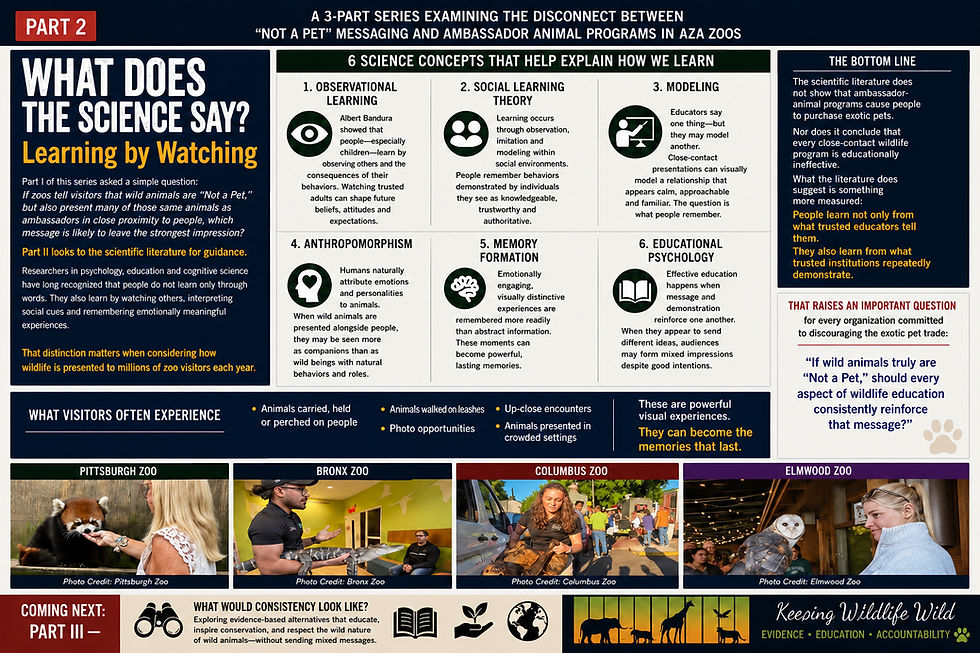
If zoos tell visitors that wild animals are “Not a Pet,” but also present many of those same animals as ambassadors in close proximity to people, which message is likely to leave the strongest impression?
Part II turns to the scientific literature for guidance.
For decades, researchers in psychology, education and cognitive science have recognized that people do not learn only through words. They also learn by observing others, interpreting social cues and remembering emotionally meaningful experiences.
That distinction matters when considering how wildlife is presented to millions of zoo visitors each year.
Observational Learning:
Psychologist Albert Bandura demonstrated that people—particularly children—learn by observing the behavior of others and the consequences of those behaviors. Individuals do not need to perform an action themselves to learn from it. Watching trusted adults or authority figures can shape future beliefs, attitudes and expectations.
When visitors repeatedly observe wild animals calmly handled, carried, posed or walked on leashes by experienced professionals, those visual experiences may influence how people think about relationships between humans and wildlife.
Social Learning Theory:
Social Learning Theory expands on this concept by explaining that learning occurs through observation, imitation and modeling within social environments.
People are more likely to remember behaviors demonstrated by individuals they perceive as knowledgeable, trustworthy and authoritative.
Zoo educators and animal care professionals are widely viewed as credible sources of information.
As a result, the demonstrations themselves may become part of the educational message.
Modeling:
Educational psychologists distinguish between what educators say and what educators model.
An educator may explain that wild animals should never be treated as pets.
At the same time, a close-contact presentation may visually model a relationship between humans and wild animals that audiences perceive as calm, approachable and familiar.
The scientific question is not whether visitors consciously reject the spoken message.
It is whether the modeled behavior also contributes to what they remember.
Anthropomorphism:
Humans naturally attribute familiar emotions, intentions and personalities to animals—a tendency psychologists refer to as anthropomorphism.
When wild animals are presented in highly controlled settings alongside people, audiences may become more likely to perceive those animals through a companion-animal lens rather than appreciating their natural behaviors and ecological roles.
Memory Formation:
Research consistently shows that emotionally engaging, visually distinctive experiences are remembered more readily than abstract information alone.
For many visitors—particularly children—the most enduring memory of a zoo visit may not be an educational sign or spoken presentation.
-It may be seeing a sloth carried into a classroom.
-A serval walking on a leash.
-A macaw perched on someone’s arm.
-Or a wild animal calmly standing beside a trainer.
These experiences can become powerful, lasting memories.
Educational Psychology:
Modern educational research suggests that effective conservation education is strengthened when message and demonstration reinforce one another.
When verbal instruction and visual experience appear to communicate different ideas, audiences may form mixed impressions despite an educator’s intentions.
The Bottom Line:
The scientific literature does not demonstrate that ambassador-animal programs cause people to purchase exotic pets.
Nor does it conclude that every close-contact wildlife program is educationally ineffective.
What decades of research do suggest is something more measured:
People learn not only from what trusted educators tell them.
They also learn from what trusted institutions repeatedly demonstrate.
That raises an important question for every organization committed to discouraging the exotic pet trade:
If wild animals truly are “Not a Pet,” should every aspect of wildlife education consistently reinforce that message?
Sources / Scientific Literature Referenced:
Albert Bandura — Social Learning Theory (1977)
Albert Bandura — Social Foundations of Thought and Action: A Social Cognitive Theory (1986)
National Academies of Sciences, Engineering, and Medicine — How People Learn II: Learners, Contexts, and Cultures (2018)
Evidence – Education – Accountability
KeepingWildlifeWild.org
