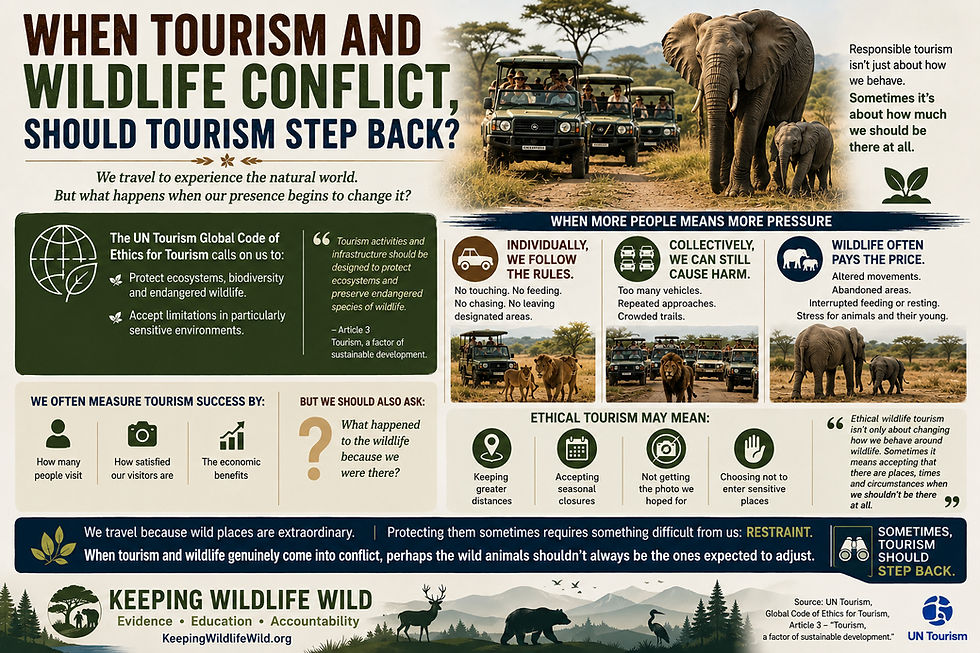
When Tourism and Wildlife Conflict, Should Tourism Step Back?
We Travel to Experience the Natural World. But What Happens When Our Presence Begins to Change It?
Wildlife tourism can do extraordinary things.
It can introduce people to landscapes they may otherwise never experience, provide economic opportunities for communities living alongside wildlife, generate support for conservation and transform an animal seen only in a book or on a screen into something suddenly real and worth protecting.
But tourism also brings something else into those wild places.
Us.
Our vehicles, boats, lodges, roads, cameras and expectations. And sometimes, simply too many of us.
That raises a question at the heart of ethical wildlife tourism:
When our desire to experience wildlife begins competing with wildlife's need to live undisturbed, who should give way?
EVEN TOURISM HAS LIMITS:
The United Nations' specialized agency for tourism, UN Tourism, provides an interesting framework for considering that question.
Its Global Code of Ethics for Tourism establishes ten principles intended to guide governments, tourism businesses, destinations, communities and travelers toward more responsible and sustainable tourism.
Article 3 focuses specifically on sustainable development. It calls upon tourism stakeholders to safeguard the natural environment, protect ecosystems and biodiversity, and preserve endangered wildlife.
But one principle is particularly relevant to wildlife tourism: tourism may need to accept limitations when it occurs in particularly sensitive environments.
That idea deserves more attention.
Responsible tourism isn't simply about finding better ways to bring people closer to nature. Sometimes it may require deciding how many people should be there in the first place.
Imagine a wildlife sighting where every visitor follows the rules. Nobody touches an animal. Nobody feeds one. Nobody intentionally chases wildlife or leaves the designated viewing area.
Individually, everyone may be behaving responsibly.
But what happens when twenty vehicles arrive?
Then fifty?
What happens when boats repeatedly approach the same animals, trails funnel thousands of visitors through sensitive habitat, or viewing areas become so crowded that wildlife must alter its movements simply to navigate around us?
At some point, the ethical question becomes larger than the behavior of any individual tourist.
The cumulative presence of tourism itself can become the disturbance.
WHEN MORE ISN'T BETTER:
The Global Code also recognizes the importance of carrying capacity. Nature tourism and ecotourism can provide genuine benefits, but those benefits depend upon respecting natural heritage, local communities and the limits of the places being visited.
In other words, there can be a point at which more tourism is no longer better tourism.
We tend to measure tourism success from the human perspective: how many people visited, how many excursions were booked, how much money entered the local economy and whether visitors went home satisfied.
Those are understandable measures.
But wildlife introduces another stakeholder whose experience rarely appears on a customer-satisfaction survey.
What happened to the animals because we were there?
Perhaps wildlife altered its movements as people approached. An animal stopped feeding or resting. A mother moved her young. A migration route became congested. Repeated human presence changed where or when animals felt comfortable enough to behave naturally.
A tourism experience can be memorable for us while simultaneously becoming disruptive for them.
Both things can be true.
ACCESS IS NOT AN ENTITLEMENT:
One of the most difficult ideas in wildlife tourism may also be one of the most important:
Wanting to experience a wild place does not automatically give us an unlimited right to enter it.
There may be seasons when an area should be closed because animals are breeding, nesting or raising young. There may be habitats where human access should remain restricted. There may be wildlife sightings where the appropriate response to another arriving vehicle isn't to squeeze it in, but to turn it away.
And there may be places where protecting what makes them extraordinary requires allowing fewer people to experience them.
That can feel contradictory. We often argue that people need to experience nature in order to appreciate and protect it, and there is truth in that.
But conservation begins to lose its meaning if our desire to experience wildlife becomes another pressure wildlife must endure.
Much of tourism is naturally designed around accommodating people. We want convenient access, predictable schedules, good visibility, close photographs and memorable encounters.
Wild animals make none of those promises.
They move. They hide. They sleep. They migrate. They avoid us.
Sometimes they simply aren't there.
Perhaps ethical wildlife tourism begins when we stop expecting wildlife to accommodate our vacation and become willing to accommodate wildlife instead.
That may mean maintaining greater distances, waiting rather than approaching, accepting a less dramatic photograph or discovering that the experience we hoped to have isn't available that day.
Sometimes it may mean not entering a sensitive place at all.
WHEN STEPPING BACK BECOMES PART OF THE EXPERIENCE:
The Global Code of Ethics for Tourism isn't a detailed animal-welfare standard. It doesn't tell a safari guide precisely how far to remain from an elephant or determine how many boats should be permitted near a whale.
Its contribution is more fundamental.
It recognizes that tourism has responsibilities to the natural world and that protecting sensitive environments can legitimately require limits on tourism itself.
That principle gives travelers, tour operators and destinations something important to consider.
Ethical wildlife tourism isn't only about changing how we behave around wildlife.
Sometimes it means accepting that there are places, times and circumstances when we shouldn't be there at all.
We travel because wild places are extraordinary. We want to see them, photograph them, remember them and hopefully help protect them.
But protecting them sometimes requires something difficult from us:
Restraint.
Because when tourism and wildlife genuinely come into conflict, perhaps the wild animals shouldn't always be the ones expected to adjust.
Sometimes, Tourism Should Step Back
Source: UN Tourism, Global Code of Ethics for Tourism,
Evidence • Education • Accountability
