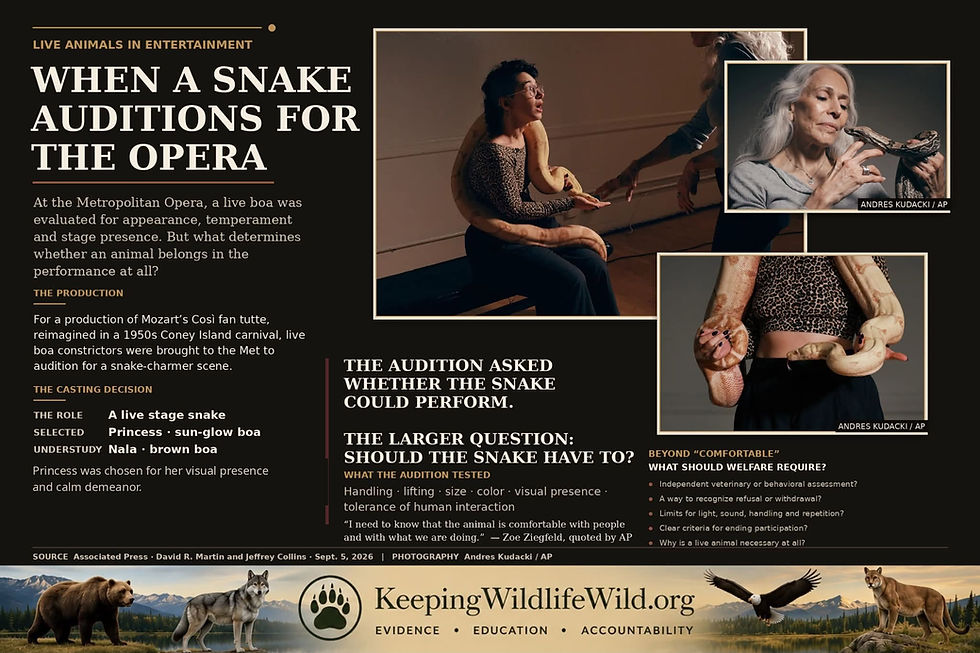
WHEN A SNAKE “AUDITIONS” FOR THE NEW YORK METROPOLITAN OPERA
ㅤ
Princess got the part at New York’s Metropolitan Opera. But an unusual casting call raises a larger question about animals in entertainment: Who is actually making the choice?
ㅤ
It sounds like a charming entertainment story: snakes recently “auditioned” for a role in the Metropolitan Opera’s production of Mozart’s Così fan tutte.
ㅤ
According to the Associated Press, performer Zoe Ziegfeld handled each snake, allowed the animal to move and wrap around them, and lifted it overhead to simulate what would happen beneath the stage lights. Ziegfeld explained that the process was intended, in part, to determine whether the animal was comfortable with people and with what the performance would require.
ㅤ
A large sun-glow boa constrictor named Princess was selected for rehearsals, while a smaller boa named Nala became her understudy. AP reports that Princess offered greater visual presence onstage, while the animal supplier described considerations such as color, size and compatibility with the performer.
ㅤ
There is nothing in the reporting that establishes that these snakes were mistreated, and evaluating an individual animal’s response is certainly more meaningful than simply assuming that every animal will tolerate the same experience. But the word “audition” deserves a closer look.
ㅤ
A human performer understands what an audition means and can choose whether to participate. A snake cannot make that decision. Princess was brought to the audition, handled, evaluated and ultimately selected by people according to the requirements of a human production.
ㅤ
Testing whether an animal appears comfortable with what we want it to do is not the same thing as giving that animal a choice about doing it. And that distinction reaches far beyond one snake or one opera.
ㅤ
Wild and exotic animals continue to appear in film, television, live performances, special events and other forms of entertainment. Sometimes the most important question isn’t whether an animal can be trained or conditioned to participate. It is whether a living animal needs to be part of the spectacle at all.
ㅤ
Modern entertainment has extraordinary alternatives available, including puppetry, animatronics, projection and digital effects. The Met itself describes this production as an imaginative transformation of Così fan tutte into a 1950s Coney Island amusement park.
ㅤ
So perhaps the snake “audition” gives us an opportunity to reconsider the question.
ㅤ
Not simply:
ㅤ
Can the animal perform the role?
ㅤ
But:
ㅤ
Why does the role require a living animal?
ㅤ
Princess didn’t choose the opera.
ㅤ
The opera chose Princess.
ㅤ
And when exotic animals become part of human entertainment, remembering who actually made that choice may be a good place for the conversation to begin.
ㅤ
Source: Associated Press, Sept. 5, 2026.
ㅤ
Complete Article
KeepingWildlifeWild.org
