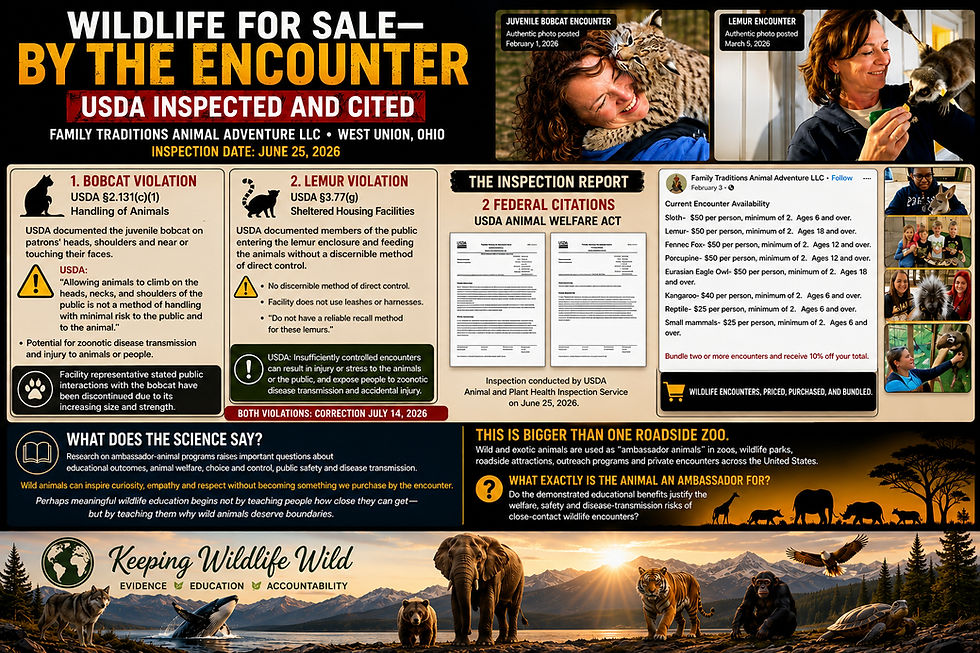
USDA INSPECTED AND CITED:
A recent federal inspection of Family Traditions Animal Adventure, an unaccredited animal facility in West Union, Ohio, provides a revealing glimpse into a much larger conversation surrounding the use of wild and exotic animals for public encounters.
On June 25, 2026, USDA inspectors reviewed photographs and video posted to social media documenting encounters involving a juvenile bobcat and lemurs.
What they found resulted in two federal Animal Welfare Act citations.
USDA documented the juvenile bobcat on patrons’ heads and shoulders and near or touching their faces.
Inspectors cited the facility under §2.131(c)(1), Handling of Animals, stating:
“Allowing animals to climb on the heads, necks, and shoulders of the public is not a method of handling with minimal risk to the public and to the animal.”
USDA warned of potential zoonotic disease transmission and injury to animals or people. The facility representative told inspectors that bobcat interactions had already been discontinued because of the animal’s “increasing size and strength.”
Inspectors also reviewed photographs and video showing members of the public entering the lemur enclosure and feeding the animals without a discernible method of direct control.
The facility was cited under §3.77(g). According to USDA, the facility representative said they did not use leashes or harnesses and “do not have a reliable recall method for these lemurs.”
Both violations carried a correction deadline of July 14, 2026.
But this story is bigger than one facility.
Earlier this year, Family Traditions advertised an extensive menu of purchasable encounters:
Sloth • Lemur • Fennec Fox • Porcupine • Eurasian Eagle Owl • Kangaroo • Reptiles • Small Mammals
Prices ranged from $25 to $50 per person, with a minimum of two participants.
And customers were offered:
“Bundle two or more encounters and receive 10% off your total.”
That advertisement illustrates a much broader issue.
Across the United States, wild and exotic animals are presented as “ambassador animals” at zoos, wildlife parks, roadside attractions, outreach programs and private encounters.
The circumstances and standards vary enormously, and not every ambassador-animal program is equivalent.
But when close contact with wildlife becomes something that can be priced, purchased and bundled, an important question deserves asking:
What exactly is the animal an ambassador for?
Research into ambassador-animal programs presents a considerably more complicated picture than the assumption that getting closer to wildlife automatically produces greater conservation awareness. Questions remain about educational outcomes, animal welfare, choice and control, public safety and disease transmission.
The issue isn’t whether people enjoy these encounters.
Clearly, they do.
The more important question is whether human enjoyment and commercial opportunity are sometimes being confused with conservation and education.
WHAT DOES THE SCIENCE SAY?
Wild animals can inspire curiosity, empathy and respect without becoming something we purchase by the encounter.
Perhaps meaningful wildlife education begins not by teaching people how close they can get—
but by teaching them why wild animals deserve boundaries.
Evidence – Education – Accountability
KeepingWildlifeWild.org
