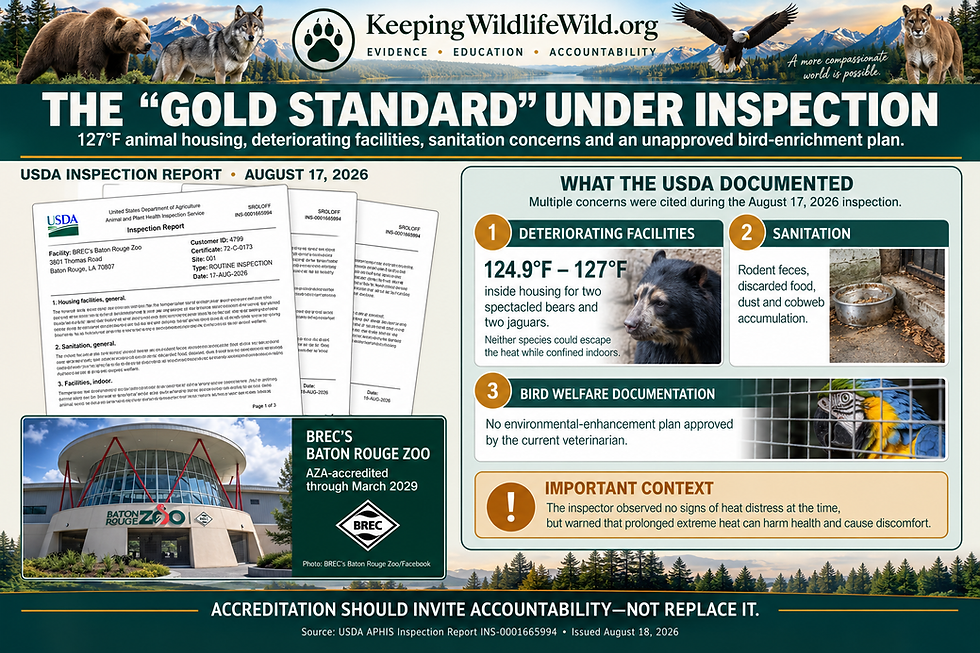
THE AZA “GOLD STANDARD” UNDER INSPECTION AT THE BREC’s BATON ROUGE ZOO
127°F animal housing, deteriorating facilities, sanitation concerns and an unapproved bird-enrichment plan.
A USDA inspector documented temperatures as high as 127°F inside animal housing at the AZA-accredited BREC’s Baton Rouge Zoo—along with rusted primate doors, deteriorating goat housing, sanitation concerns and an unapproved bird-enrichment plan.
ㅤ
The Association of Zoos and Aquariums presents its accreditation program as the “gold standard” of professional animal care. AZA also says that safety and security are of the utmost importance in ensuring animal welfare.
ㅤ
But an August 17, 2026, USDA inspection of BREC’s Baton Rouge Zoo in Louisiana, which is accredited by AZA through March 2029, documented conditions that raise serious questions about what those assurances mean between accreditation inspections.
ㅤ
TEMPERATURES REACHED 127°F INSIDE ANIMAL HOUSING
ㅤ
The most alarming finding involved the indoor housing used by two spectacled bears and two jaguars.
ㅤ
At approximately 1 p.m., the USDA inspector noticed a significant increase in temperature upon entering the building. Using a government-issued Kestrel meter, the inspector recorded indoor temperatures ranging from 124.9°F to 127°F.
ㅤ
A facility representative reportedly could not say whether the air-conditioning system had been damaged by the bears or whether the building did not have air conditioning.
ㅤ
During public exhibition hours, the spectacled bears were kept exclusively outdoors, while the jaguars could move between indoor and outdoor areas. After exhibition hours and throughout the night, however, both species were confined inside the building.
ㅤ
According to the USDA:
ㅤ
“Neither species had the option to escape the heat while in the indoor portion of the enclosure.”
ㅤ
The report states that the zoo had been doing nothing differently overnight to mitigate the high temperatures. After speaking with the inspector, the facility said it intended to leave doors open to improve airflow at night.
ㅤ
The inspector noted that the bears and jaguars were not exhibiting signs of heat distress during the inspection. That observation matters—but it does not eliminate the danger associated with prolonged exposure to extreme temperatures. The USDA warned that such exposure can harm animal health and cause discomfort.
ㅤ
Weather data cited in the report show that Baton Rouge reached 96.1°F with a heat index of 108°F during the afternoon of August 17. Overnight temperatures remained between approximately 90°F and 87.1°F, with heat-index readings between 97°F and 99°F.
ㅤ
The USDA directed the zoo to ensure that indoor housing was adequately heated or cooled to protect animals from temperature extremes. The correction deadline was August 24, 2026.
ㅤ
THE INSPECTION DOCUMENTED ADDITIONAL PROBLEMS
ㅤ
The extreme indoor heat was not the only concern.
ㅤ
The USDA found excessive rust on shift doors used for two species of macaques. The primates could come into contact with the affected surfaces, and the inspector warned that rust can compromise structural integrity and prevent proper cleaning and sanitation.
ㅤ
The zoo was directed to correct that condition by September 18, 2026.
ㅤ
Inspectors also found that wooden barn doors leading to the goats’ indoor area were deteriorating near the bottom. Missing paint and splintered wood created sharp points that could increase the risk of injury.
ㅤ
In a building housing ambassador animals—including prairie dogs, chinchillas and a ferret—the USDA described animal enclosures as being situated among storage materials, building supplies, enrichment items, office supplies and other equipment.
ㅤ
An HVAC closet near the chinchilla enclosure contained accumulated rodent feces, discarded lettuce and hay. The inspector warned that these conditions could attract or harbor disease-transmitting pests.
ㅤ
The building housing a male zebra also had excessive cobwebs and brown dust on rafters, ceilings and box fans. According to the USDA, the accumulation indicated inadequate cleaning and the possible presence of pests that could present health risks.
ㅤ
Those sanitation conditions were to be corrected by September 18, 2026.
ㅤ
AN UNAPPROVED BIRD-ENRICHMENT PLAN
ㅤ
Finally, the USDA found that the zoo did not have an environmental enhancement plan for its birds approved by the current attending veterinarian, who began working at the facility on June 8, 2026.
ㅤ
Such plans are intended to promote birds’ psychological well-being through species-appropriate environmental enrichment. The USDA warned that failure to develop and follow an approved plan can negatively affect animal health and welfare.
ㅤ
The correction deadline for that finding was August 31, 2026.
ㅤ
ACCREDITATION SHOULD INVITE ACCOUNTABILITY—NOT REPLACE IT
ㅤ
These findings do not establish that every aspect of animal care at BREC’s Baton Rouge Zoo is deficient. A USDA inspection documents conditions observed at a particular time, and the report gave the zoo opportunities to correct them.
ㅤ
But accreditation should not be treated as evidence that serious problems cannot occur.
ㅤ
AZA tells the public that its logo identifies institutions dedicated to excellent animal care. When federal inspectors document temperatures approaching 127°F, deteriorating animal housing, sanitation problems and missing welfare documentation at an accredited zoo, the appropriate response is not to dismiss the findings as exceptions.
ㅤ
The appropriate response is transparency.
ㅤ
Were the cooling problems immediately corrected? How long had the bears and jaguars been confined overnight in those conditions? Were the macaque doors, goat housing and sanitation deficiencies repaired by their deadlines? Has the bird-enrichment plan now been approved and implemented?
ㅤ
A “gold standard” should represent more than successfully passing an accreditation review every five years. It should require effective maintenance, vigilant daily oversight and prompt public accountability when conditions fall below the standards animals deserve.
ㅤ
Source: USDA Animal and Plant Health Inspection Service, Inspection Report INS-0001665994, routine inspection conducted August 17, 2026, and issued August 18, 2026.
ㅤ
Related Reading:
“USDA Citations at AZA-Accredited Zoos”
Examine USDA citations involving three AZA-accredited zoos and the questions they raise about animal care, welfare and accountability behind the “gold standard” of accreditation.
ㅤ
KeepingWildlifeWild.org
Evidence • Education • Accountability
How You Can Help:
Awareness is the first step toward meaningful change. Help advance evidence-based education, transparency and accountability by sharing this article with others.
Together, we can encourage a more informed conversation about the treatment and protection of wildlife.
